
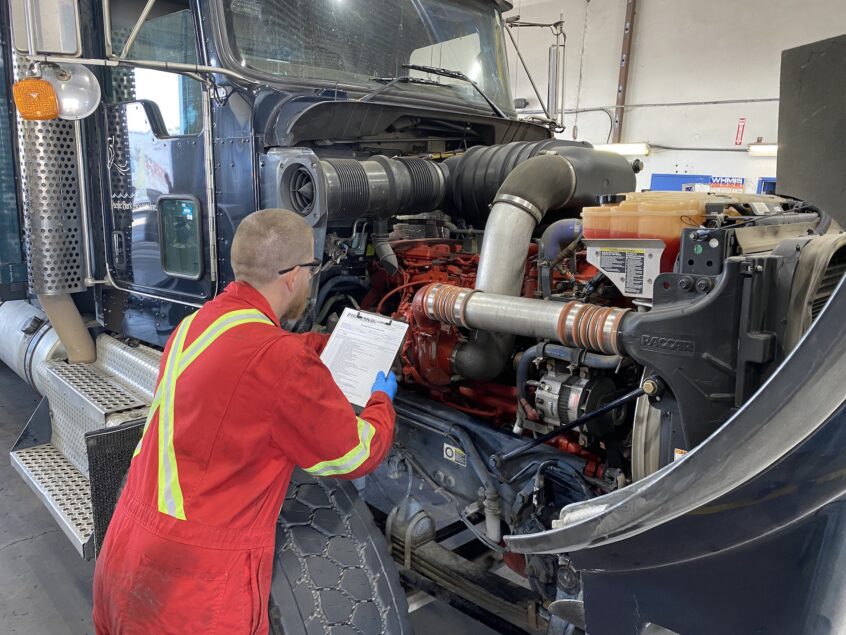
Operating a commercial semi-truck means you’re relying on high-performance machines that handle massive loads across long distances. When something malfunctions, your truck will almost always provide early warning indicators. Recognizing when your rig requires professional attention allows you to address issues before they compromise safety, fuel efficiency, or operational uptime. Here’s what you need to know:
Why Early Diagnostics Prevent Expensive Heavy-Duty Truck Repairs
Modern commercial trucks rely on complex networks of electronic control units (ECUs), sensors, and hydraulic systems. When a minor issue develops, such as a slightly misfiring fuel injector or a sticking EGR valve, it places extra stress on surrounding engine components.
By scheduling engine diagnostics, fleet managers and independent owner-operators can catch minor fault codes before they cascade into catastrophic mechanical failures. At Dieseltech, our computerized diagnostic scans pinpoint exact error codes so our technicians can resolve the root cause of the problem, helping you avoid emergency roadside assistance, costly repairs, and the need for 24/7 truck repair whenever possible.
Dashboard Warning Lights That Should Never Be Ignored
Your dashboard is your first line of defence. While a standard Check Engine light might indicate a minor sensor issue, red warning icons demand immediate attention:
- Stop Engine Light (Red): Indicates a critical fault such as dangerously low oil pressure or severe overheating that requires shutting down the engine immediately to prevent engine failure.
- Check Engine / Malfunction Indicator Light (Amber): Signals an active fault code in the engine management or emissions system that needs diagnostic evaluation promptly.
- DPF / Aftertreatment Light: Warns that the diesel particulate filter is reaching soot capacity and requires an active regeneration or professional cleaning.
- ABS / Brake System Light: Points to air pressure irregularities, sensor failures, or wheel speed discrepancies in the braking network.
Loss of Engine Power Under Load
If your semi-truck struggles to maintain speed on steep highway inclines or lags during acceleration while hauling a full load, your engine is suffering from power loss. This condition often stems from:
- Restricted Fuel Flow: Clogged fuel filters or failing fuel pumps reduce the pressure needed for proper combustion.
- Boost Leaks: Damaged charge air coolers, split turbo hoses, or faulty wastegates prevent the turbocharger from delivering adequate intake air pressure.
- Exhaust Restrictions: A plugged DPF restricts exhaust flow, creating backpressure that bogs down the engine.
- Diagnosing power loss early prevents engine overheating and reduces stress on the turbocharger and valvetrain.
Increased Fuel Consumption Without Explanation
Fuel is one of the largest ongoing expenses in commercial trucking. A sudden or gradual drop in fuel efficiency without changes in payload weight, route terrain, or driving habits indicates an underlying mechanical or electronic flaw.
Unexplained fuel spikes are typically triggered by stuck-open fuel injectors, failing oxygen/NOx sensors, improper engine timing, or dragging brake shoes. Diagnostic testing measures real-time sensor data and fuel trim ratios to identify why your engine is burning excess diesel.
Excessive Exhaust Smoke From the Engine
The colour of exhaust smoke emitted from your tailpipe provides direct insight into what is happening inside the combustion chamber.
Black smoke causes
Black smoke indicates an overly rich air-fuel mixture, meaning too much fuel is being injected or not enough air is entering the cylinder. Common causes include:
- Clogged air intake filters or restricted air piping.
- Faulty or carbon-fouled fuel injectors delivering excessive fuel.
- Turbocharger malfunction or boost leaks.
White smoke causes
White smoke occurs when unburnt diesel fuel passes through the exhaust system, or when coolant enters the combustion chamber. Typical causes include:
- Blown head gaskets or cracked cylinder heads allowing engine coolant leaks.
- Incorrect fuel injection timing or low cylinder compression.
- Failed glow plugs or intake air heaters during cold starts.
Blue smoke causes
Blue smoke is a clear indicator that the engine is burning oil. Primary causes include:
- Worn piston rings or scored cylinder walls allowing oil past the pistons.
- Degraded valve stem seals letting oil drip into the intake or exhaust ports.
- Failing turbocharger seals leaking oil directly into the air intake or exhaust housing.
Hard Starting or Intermittent Engine Shutdown
A semi-truck engine should start smoothly and idle consistently. If the engine cranks excessively before firing, cuts out unexpectedly while idling at a loading dock, or dies during highway cruising, your electrical or fuel delivery system is compromised.
Intermittent shutdowns are frequently caused by failing crankshaft/camshaft position sensors, loose wiring harnesses, fuel rail pressure drops, or ECU power supply issues. Because an unexpected engine stall on a busy highway poses severe safety risks, immediate computer diagnostics are vital.
Transmission Shifting Problems During Highway Driving
If your fleet uses manual, automated manual (AMT), or fully automatic transmissions, smooth gear engagement is necessary for power delivery. Warning signs of transmission distress include:
- Harsh or Delayed Gear Engagement: Slipping gears, delayed upshifts, or rough downshifts.
- Fault Codes on AMT Controllers: Error messages displayed on the gear selector interface.
- Clutch Drag or Overheating: Difficulty changing gears from a stop or high transmission fluid temperatures.
- Addressing shifting anomalies through diagnostic scanning helps protect gear sets, clutch actuators, and transmission control modules from premature destruction.
Brake Performance Changes or Air Pressure Issues
Air brake systems are engineered with multiple safety backups, but any deviation in air pressure recovery time or braking responsiveness requires immediate evaluation. Pay close attention to:
- Slow air pressure buildup during pre-trip inspections.
- Rapid air drops when applying the foot pedal.
- Unresponsive or pulling brakes during heavy deceleration.
- Frequent cycling of the air dryer purge valve.
Professional diagnostic checks evaluate compressor output, governor settings, air lines, and ABS wheel sensors to keep your rig fully compliant with Commercial Vehicle Safety and Enforcement (CVSE) regulations.
Aftertreatment System Problems and Regen Failures
Modern diesel engines rely on sophisticated aftertreatment setups including Diesel Oxidation Catalysts (DOC), Diesel Particulate Filters (DPF), and Selective Catalytic Reduction (SCR) systems to limit emissions.
When these systems encounter faults, the truck’s engine control module will often enter a derate mode, severely limiting horsepower and vehicle speed. Common warning signs include:
- Inability to complete a parked (forced) DPF regeneration.
- Excessive Diesel Exhaust Fluid (DEF) consumption or DEF quality fault codes.
- Failed SCR temperature or NOx sensors.
Diagnostic tools allow technicians to force manual regenerations, test DEF dosing pumps, and reset derate timers after clearing system faults.
Electrical Fault Codes Appearing More Frequently
Commercial trucks endure constant vibration, moisture, and temperature fluctuations, all of which take a toll on wiring harnesses, relays, and sensors.
If your dash displays intermittent sensor errors, erratic gauge readings, or recurring fault codes that disappear and return, your electrical system is experiencing signal instability. Advanced diagnostic equipment maps out CAN-bus communication channels to locate frayed wires, corroded ground connections, or failing control modules before total electrical failure occurs.
How Diagnostics Help Prevent Roadside Breakdowns in Vancouver
Navigating demanding freight corridors across Vancouver puts significant demands on commercial vehicles. Steep grades, stop-and-go urban traffic, and variable weather accelerate wear on heavy-duty components. Dieseltech’s routine electronic scanning during scheduled maintenance catches thermal and mechanical friction points early. Identifying a failing sensor or leaking hose in the shop can prevent unexpected vehicle stalls or worse issues. When a warning light illuminates, or your engine exhibits unusual behaviour, relying on your go-to technicians is essential for getting back on the road quickly.
Our 20,000-square-foot facility in Coquitlam is fully equipped with advanced computerized diagnostic technology. Dieseltech’s certified heavy-duty mechanics accurately identify system faults and perform precision repairs.
Contact Dieseltech today to schedule your diagnostic service!